
01
Slide movement
Your piece slides in the input direction and stops just before a wall or boundary.
Inputs that can't move your piece even one cell are ignored (no move or time added)
A route-design puzzle where you cannot stop freely. Plan stopping points, clear all spots, then stop on the exit.
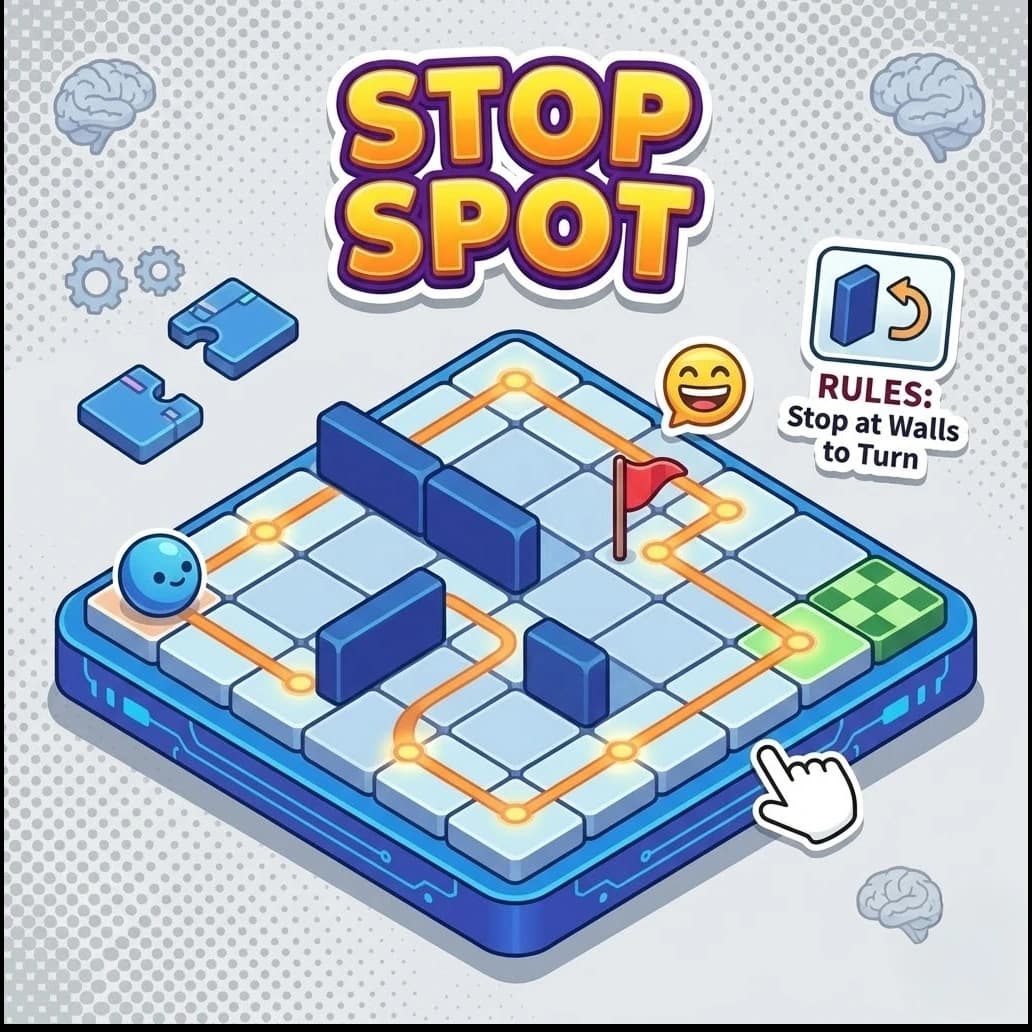
Stop Spot is a route puzzle built around slide movement: once you move, you cannot stop until hitting a wall or boundary. Spots count only when you stop on them, not when you pass through. Clear all spots and then stop on the exit to finish. Higher levels increase grid size and spots while reducing wall density, making stops harder to control.
Your piece slides in the input direction and stops just before a wall or boundary.
A spot is counted only when you stop on it. Passing through does not count.
You clear only when all spots are done and you stop on Exit.
Plan your stop graph first, then collect all spots with minimal detours.
99 stages total. Every 11 stages, the level increases.
| Level | Stages | Grid | Spots | Wall density |
|---|---|---|---|---|
| 1 | 1–11 | 6×6 | 0–2 | 16% |
| 2 | 12–22 | 7×7 | 1–3 | 15% |
| 3 | 23–33 | 8×8 | 2–4 | 14% |
| 4 | 34–44 | 9×9 | 3–5 | 13% |
| 5 | 45–55 | 10×10 | 4–6 | 12% |
| 6 | 56–66 | 11×11 | 5–7 | 11% |
| 7 | 67–77 | 12×12 | 6–8 | 10% |
| 8 | 78–88 | 13×13 | 7–9 | 9% |
| 9 | 89–99 | 14×14 | 8–10 | 8% |
Quickly reading stoppable cells and switching direction trains processing speed.
Keeping future stop points and remaining spots in mind strengthens working memory.
Reasoning backward from wall/boundary stops to build an optimal route trains logic.
Suppressing unnecessary inputs and landing on precise stops trains control.
Choose a Time Attack




Read these next to connect the full picture of cognitive measurement and training.